Crete and Medical Care on a Cruise Ship
The sea days don’t inspire a lot of storytelling for a blog. We did some exploration of the ship (the thing is gigantic and I don’t think we made to every floor the entire two weeks). We did notice an elevator at the end of our hallway that we hadn’t noticed before so we took it from our perch on the 12th floor down to the 7th, where we found a secret swimming pool and a breezy back deck over the stern. We had dinner at the steak restaurant, which was a very reliable place to eat. Good food served well.

Have I mentioned the bread aboard the Sun Princess? I hardly ever eat bread. If it isn’t warm, crusty with a soft and chewy interior, I consider it wasted calories. The bread at almost all of the restaurants on The Sun Princess provided just the kind of bread I can’t resist. I succumbed at almost every meal and resigned myself to a cruise related weight gain.
On this sea day we also learned that someone had turned in the wallet that Bob lost in Paris! I found them much easier to work with than the Barcelona Airport, so I had put in documentation in hopes of this happening. And voila! A brown wallet with an attached AirTag and the name Bray had been turned in. Of course, they couldn’t (or wouldn’t) tell us any more than that, so we had no idea if the $300 or so dollars were there, or the credit cards and Bob’s driver’s license, but they were willing to return it to our home in Virginia. It would only cost us 12 Euros to claim it. So, we paid up and requested the return. Great! But the actual shipping to Norfolk Virginia would only cost 94 Euros! Still, if we were lucky and the wallet was found by a saint, it would pay for itself, right? Oh, but then there is the tariff. It will cost 76 Euros additional to ship it because of the tariff. OK, but we would still be ahead right? But they want to deliver on a day when we would not be home. We can change it, but that would be another 6 Euros. Oh well, in for a nickel right? I’ll keep you posted.
The next day was Crete, Greece, where we had booked a beach day at a nearby Marina in the Cretan Sea. It is billed as a great resort with shallow, calm, warm water overlooking the island of Theodorou, home of the wild kri-kri goat. But it seemed there might be a problem. Bob had developed a rash over his back and chest which was becoming more and more irritated. We weren’t sure if it was caused by sun exposure, something in the pool water, or something else, but we had clearly avoided thinking about it as long as we could, and he was becoming miserable. So, in our never-ending research of seeing how other countries handle healthcare, we headed for the ship’s medical center.
And as has been our experience, his problem was handled quickly and efficiently. He was initially assessed by a nurse who had worked in an ICU during covid, and it was clear he still suffered from PTSD. He enjoyed his worked on the cruise ship and was grateful that most things could be handled without the horrific issues rampant in covid. Then we saw the ship’s doctor whose background was in Emergency Medicine, making perfect sense for the ship’s needs. She prescribed a short course of prednisone and some loratadine, and we were provided with the medications and all the paperwork necessary to send a claim to our travel insurance.

Although we were done within a half hour, we didn’t think a trip to a beach for a day was a great idea, and Bob wanted to hang out on the ship and get some rest. So, I decided to get a day pass to the city of Chania to wander around and see Crete. And that’s when I was confronted by the Greek alphabet.
Thus far, we had been to Spain and Italy, and although my language education only encompassed 2 years each in French and German, I had actually found it fairly easy to read those languages and make an educated guess at what they were trying to tell us. I can’t handle the spoken word at all. Like most of us the world over, we talk a lot faster than the basic student of language can make out. And of course, in both Spain and Italy, many people speak English. (I am always embarrassed by my uni-language skills when so much of the world is so much better). But when I got off the shuttle in Chania, it became clear that the Greek alphabet was completely unknown to me. I wandered through a few shops, trying to look cosmopolitan, and while some people I encountered did speak English, many did not, and we communicated through smiles and gestures. I had hoped to find old town and the sea, but the street signs were all Greek to me. Defeated, I got back on the shuttle to return to the ship.


In the parking lot, I saw a man under an umbrella and a few people nearby and they were all waiting on the Chania hop-on, hop-off bus. You know the ones. Every city in the world has them. With headphones in many languages. And this one was a 90-minute round trip for 15 Euros—cheapest one I’ve ever seen. So I hopped on, plugged in my headphones and got a great glimpse of the beauty of this historic port city.
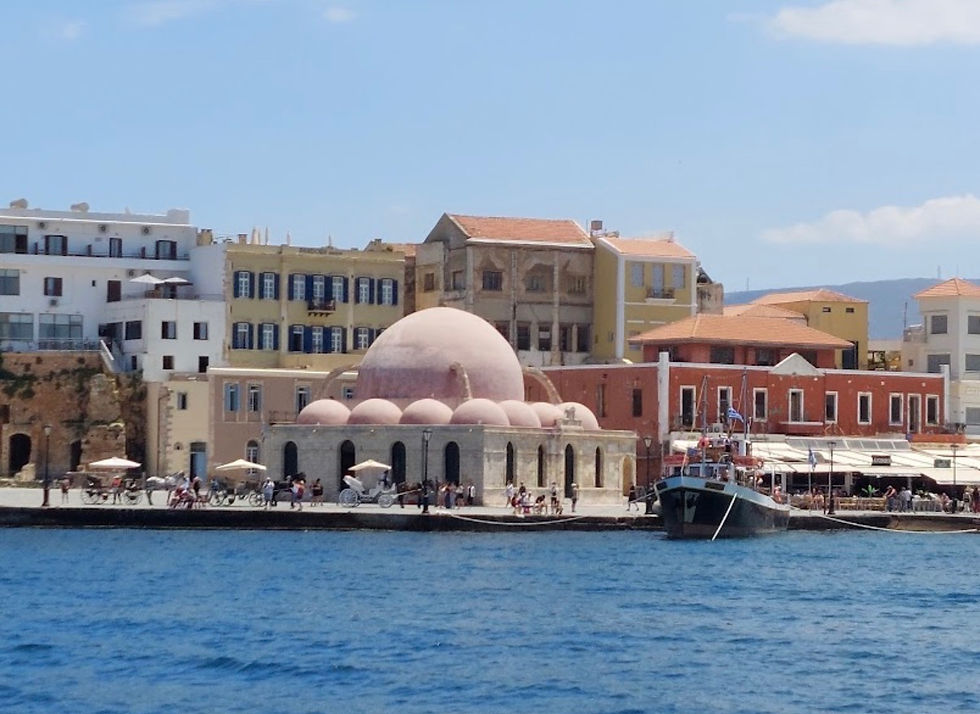
Chania sits on the northwest coast of Crete, a centuries old mix of Minoan culture, beautifully preserved Venetian mansions, and a Roman acropolis. It is the gateway to the ruins at Knossos and the legendary King Minos. Minos was a mythical king famous for his powerful navy, his labyrinth and the Minotaur. He was a son of Zeus (can’t get a better pedigree) and the Phoenician princess Europa. Poseidon himself helped Minos claim the throne by sending a magnificent white bull as a sign of divine favor. Minos was seen as a just ruler, establishing a code of laws, and turned Crete into a dominant naval power. Upon his death, his reputation for fairness caused him to become one of the three judges of the dead in the underworld. Nice to know he gives me a chance.
However, nothing with the gods is ever simple. Poseidon wanted Minos to sacrifice the while bull, and Minos refused. In revenge, Poseidon caused Minos’s wife, Pasiphae to fall in love with the animal and eventually she gave birth to the Minotaur, a creature with the body of a man and the head of a bull. Imagine the necessary neck muscles! Minos had the Minotaur imprisoned in a massive and inescapable labyrinth beneath his palace, and each year forced Athens to send seven youths and seven maidens as a sacrifice in the labyrinth. So much for his fairness. Eventually the hero Theseus killed the monster with help from Minos’s daughter Ariadne. And you think your family has problems.


I didn’t hop off my ride until we returned to the port, but I had a great time learning about the city, and seeing the beautiful views and architecture. So, in the end I overcame my weakness with the Greek alphabet and had a wonderful and educational day on Chania, Crete. And Bob was feeling much better when I got to the ship. We went back to the Seafood restaurant for dinner—our favorite of the specialty restaurants and had more yummy bread and delights of the deep. Tomorrow is another sea day.


Comments